
A COMMUNICATIONS PRACTICE BUILT ON BRAND ARCHITECTURE
What are you
talking about?
Actually.

TellHaus is a communications practice built on brand architecture. I find what's structurally true about your company, then root every piece of communication in it so it's sturdy AF.
That's the Tell in TellHaus. The Haus is what your messaging is made of: a structure so sound your people don't just hear you, they move in.
The way you talk about your brand is the part your people feel. The architecture beneath your words is why it keeps making sense (or doesn’t) no matter who you’re telling or where.
TellHaus works for founders and brands with mismatched walk and talk. Sometimes it used to be right, often times it was never quite right, and possibly there's nothing overtly wrong, it just doesn't… work.
Pull up your website, your social media and that speech you gave at your last company town hall. Call back some toasts from holiday parties past, ask your sales team how they sell you and HR how they hire. Read it like a stranger would. Hear it like an eavesdropper. If you personally are the marketing, sales and HR team all in one, notice what you say when. Can your spouse tell folks what you do and get it right? What about your college roommate or sibling?
Chances are, between the toast, the homepage, the roommate conversation and your social media, you've told a thousand versions of what your company does. The people who know you believe in you. But the people you serve? Can they even hear you in all the noise?TellHaus exists to make sure the version of your company you believe in is the version your market hears.
You Already Feel It.By the time a founder contacts me, they already feel it. One founder described it best by saying:
“I don’t feel ready. I need to be ready.”
Another said:
“It doesn’t feel like the mic is on.”
They’d already done the right things, but the messaging still felt hollow.
The PremiseThe way your brand communicates in market is the deliverable. Brand architecture is the method.
Every founder I work with has been sold messaging before.
Decks, frameworks, a rebrand, a voice guide gathering dust in a shared drive and a list of ideas in someone’s head. The work was creative, competent, correct and still structurally deficient.
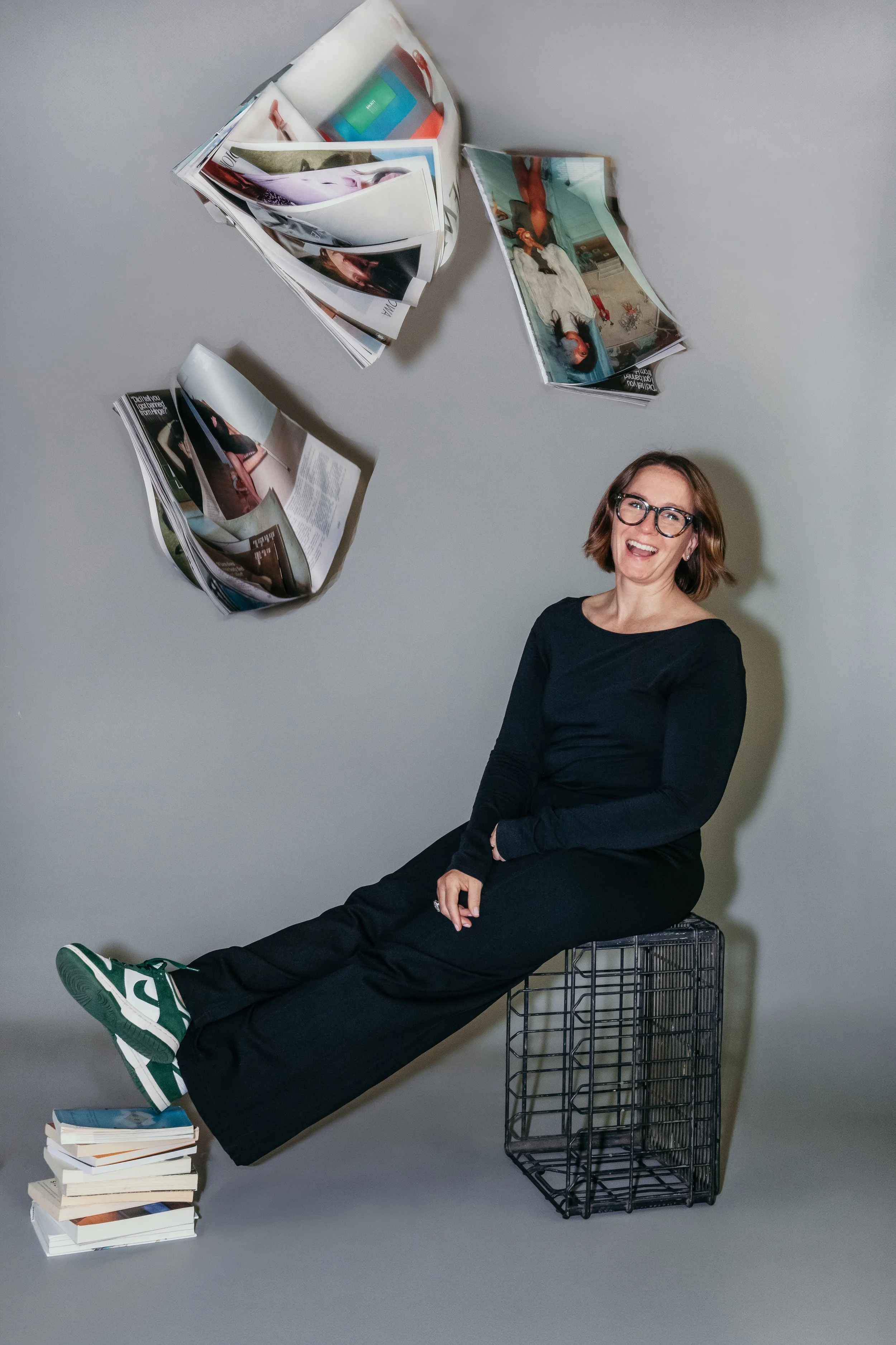
I flip the traditional script. Before a single line of copy gets written, I find the structure: why the company came to be, how they exist in the world and what they do. Then I look around at the world the company exists in and it’s competing with and identify opportunities. The ideas and planning come next and then, the execution. If I do my job right, the work feels like it’s been yourself all along and you know how to talk about it in every context.
I learned the structural work over fifteen years at:
Grey
·
DDB
·
JWT
·
BBDO
·
Grey · DDB · JWT · BBDO ·
building brands for L'Oréal, DeBeers, Johnson & Johnson, and GSK.
“Every jeweler in the category uses the same words. None of us sound unique anymore. Marisa mapped out exactly where I stood against everyone else and what I saw was evidence, not branding, backed by facts, not vibes. I was excited to build the branding from the work we did and talk about my company in a way that tells the right people we are for them and stand apart from the rest”
— Founder of a custom high jewelry brand, (name withheld while we build).
"It's not like I know exactly what I'm doing. It IS like I am finally clear on exactly who I am for this business and who we are for the world."
— Francie Webb, Founder, Chief Vision Officer, Go Milk Yourself
The FrameworkThe method is architectural: find, draw, build, hold.
The method is rational, the stakes are emotional.
I
Find It
I don't write a thing until I know your thing.
Find it starts at the bedrock (Which sometimes means shoveling shit out of the way. I'm fine to get my hands dirty.) and climbs from the depths to the surface. I ask you questions and listen to more than just the words you use to answer. I lead you through working sessions to discern why you believe what you believe, how you show up and what you do. What surfaces is rarely new news. It's usually more like shuffling into your own kitchen at midnight, sleepy and in the dark. You already know where everything is. You just can’t see it anymore.
This is your thing you haven't been able to say out loud. At the end, I hand you a foundational document we surfaced together.
II
Draw It
Draw it peers out at the terrain
After phase one, I do deep work to search, gather (and validate) and make sense of the world around your brand. This starts with a lot of facts: what's happening out there and how it affects the market, your category, the competitive set, the noise, the blank spaces and the buyer dynamics. I present Draw it as a formal top line with a positioning recommendation, the place the brand can credibly hold, argued from evidence, not guessed at. You get a giant road map of a deliverable I like to call the Atlas. (remember those?)
III
Build It
And then, we build.
Build It works with your foundation and your plot of brand-land to frame your house. Atelier, if you're fancy. This starts with constructing your vernacular and verbatim, it moves into brand expressions and strategy. These are your tools to use wherever your brand talks and walks. And then, we choose one fundamental medium and prove our concept there.
IV
Hold It
The hardest work is last.
Houses are for living in and require care. Which is hard work, especially if the person who lives there isn't handy. A brand's house works the same way: the work drifts, the language shifts, a brief gets ignored, execution turns blind to the thinking. Hold It is where I reside as a fractional teammate after launch. I keep the strategy alive in the work: the content, the campaigns, or new expressions. I let you say "probably yes" to shareholders, stakeholders and the sales team and we execute the right way for the brand you believe in.
FAQs
-
Honest, curious ones. When I first started to do this work, an advisor told me to automate my work as much as I could so I didn't have to think a lot. And, valid point but... I want to think. If you can let me in, tell me things and answer my questions, I bet I can help.
-
You can expect a transparent process, respect for your company values (I'll help you craft those too), a point of view, a partner in the trenches, a casual rule breaker and some ill-timed tech mishaps.
-
No. My schedule is very flexible and I like it that way.
-
Yes, within reason. I can't go to Tokyo tonight. Those days are over.
-
Once upon my 20s I had an Executive Creative Director who did not like the account management team (not just me, I swear). I asked her how long it would take to complete a project I'd just briefed in. And she said to me, "How long is a line, Marisa?" And I swore right then and there that I'd never say that to anyone. And yet.
The best way to answer that is, it depends. It depends on what you need from me. I always scope Find It and Draw It together. I prefer to scope Find It, Draw It and Build It together and leave Hold It as optional. I do not scope Build It or Hold It alone. I can't do my best work for you that way.
If we decide to explore working together, I'll create a scope of work for you that outlines my work and your investment. Engagements start in five figures and span a three-month minimum. I usually structure a 50% initial payment followed by 25% increments at two mile markers that we agree on before we get started. Hold It is always scoped separately once we know what I'll be doing.
I no longer accept hourly rates. I require a contract.
Tell me.
No pitch, no pressure.
Just a conversation about what you're building and whether I'm the right person for the architecture.